
Harnessing the Six Sources of Influence: A Blueringed Consultant’s Toolkit for Lasting Change
As consultants at Blueringed, we thrive on guiding organisations through transformation.
Whether it’s streamlining operations or fostering innovation, the real challenge often lies not in crafting the strategy, but in ensuring it sticks.
Enter the Six Sources of Influence model—a straightforward framework from the book Influencer: The Power to Change Anything by Kerry Patterson and colleagues. This 2×3 matrix dissects why people resist change and how to overcome it by targeting motivation and ability across personal, social, and structural levels. It’s simple to whiteboard during client workshops and powerful enough to multiply your impact.
At Blueringed, we’ve applied this model to everything from sales team overhauls to sustainability initiatives. By addressing all six sources, we help clients achieve results that endure, not just evaporate after the project ends. In this post, we’ll break it down with practical strategies and professional examples, drawing on insights from change experts. Let’s explore how you can wield it in your next engagement.
The Framework: Motivation Meets Ability
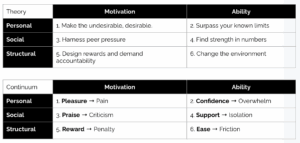
Imagine change as a Venn diagram: at the centre is success, but only if you tackle both want (motivation) and can (ability). Slice this by three dimensions—personal (individual mindset and skills), social (peer and network dynamics), and structural (environment and systems)—and you get six levers to pull.
The beauty? It’s diagnostic. Start by asking targeted questions for each source, then design interventions. Research shows leveraging multiple sources boosts success rates dramatically—up to ten times in some cases. For consultants, this means moving beyond advice to co-creating ecosystems where change thrives.
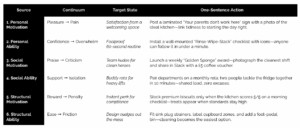
So, we’ll review the model in three tables below. The 1st being the theory, 2nd the desired to least desired response and, 3rd a combination with an example. Hopefully, this will strengthen your understanding.
Now, in some organisations the staff room / kitchen can be a bit of a mess – see how the influencer model can be play out:
Source 1: Personal Motivation – Do They Want It?
Key Strategy: Make the undesirable desirable by linking behaviours to core values.
People act when they care. If a team sees a new process as a chore, motivation wanes.
Example: At a mid-sized retailer, Blueringed consultants helped shift staff from paper-based inventory checks to a digital app. We connected it to employees’ pride in accurate stock—reducing customer frustrations they often heard firsthand. Workshops featured stories of “hero moments” where quick checks delighted shoppers. Result? Voluntary adoption rose 40%, as staff wanted to be the reliable face of the brand.
Source 2: Personal Ability – Can They Do It?
Key Strategy: Surpass limits through deliberate practice and skill-building.
Even motivated teams falter without the know-how. Bridge this with targeted training.
Example: Implementing a CRM system for a financial services firm, we identified skill gaps via quick audits. Rather than generic sessions, we rolled out bite-sized modules—15-minute videos on lead tracking, followed by peer-led practice. One advisor, initially overwhelmed, mastered it in weeks and became a go-to mentor. Uptake hit 85%, turning a tech hurdle into a competitive edge.
Source 3: Social Motivation – Do Others Encourage It?
Key Strategy: Harness peer pressure by enlisting influencers and building accountability networks.
We mimic those around us. Surround change-makers with cheerleaders, not sceptics.
Example: For a healthcare provider adopting patient feedback loops, we mapped “vital behaviours” like daily huddles. We paired resistant nurses with enthusiastic colleagues for shadowing, creating a ripple of encouragement. Social nudges—like team shout-outs in meetings—amplified buy-in. Complaints dropped 25%, as peer validation made compliance feel communal, not compulsory.
Source 4: Social Ability – Do Others Enable It?
Key Strategy: Seek support from networks providing resources, info, or help.
Isolation kills progress. Leverage relationships to fill capability gaps.
Example: In a manufacturing client’s shift to lean processes, bottlenecks arose from siloed teams. Blueringed facilitated cross-functional “enablement pods”—engineers aiding assemblers with quick troubleshooting guides. One pod resolved a recurring defect in days, not weeks, fostering trust. This social scaffolding cut waste by 30%, proving collaboration’s quiet power.
Source 5: Structural Motivation – Does the Environment Reward It?
Key Strategy: Design cues and incentives that tie rewards to vital behaviours, used sparingly.
Environments shape habits. Subtle prompts and aligned rewards reinforce the right path.
Example: To boost a marketing agency’s content output, we redesigned the office dashboard—visible metrics celebrating timely posts over hours logged. Paired with modest bonuses for collaborative wins, it shifted focus from busyness to impact. Output doubled without burnout, as the space itself motivated quality over quantity.
Source 6: Structural Ability – Does the Environment Support It?
Key Strategy: Use tools, data, and spatial cues to make success frictionless.
Bad setups sabotage even the willing. Re-engineer surroundings for ease.
Example: For a logistics firm going paperless, paperwork lingered due to cluttered desks. We introduced mobile scanners and app integrations, plus “clean zones” with charging hubs. Drivers, once bogged down, now logged routes seamlessly. Efficiency gained 20%, highlighting how structural tweaks unlock latent potential.
Putting It All Together: Your Action Plan
The Six Sources aren’t a checklist—they’re a lens. In a Blueringed project, begin with a 30-minute mapping session: score each source on a 1-5 scale, then prioritise two to three for quick wins. Track progress quarterly, adjusting as needed. This multi-lever approach turns “shoulds” into “wills.”